Drift
Private notes that don't stay forever.
Write what you need to write.
Lock it away.
One day, without warning, it's gone.
No account. No sync. No recovery.
A quiet place for thoughts that don't need to stay.
Drift is not built for organising your life.
It is not a productivity system.
It is not a permanent archive.
It is a private space to write something down, leave it for a while, and let it disappear.
How it works
-
Write
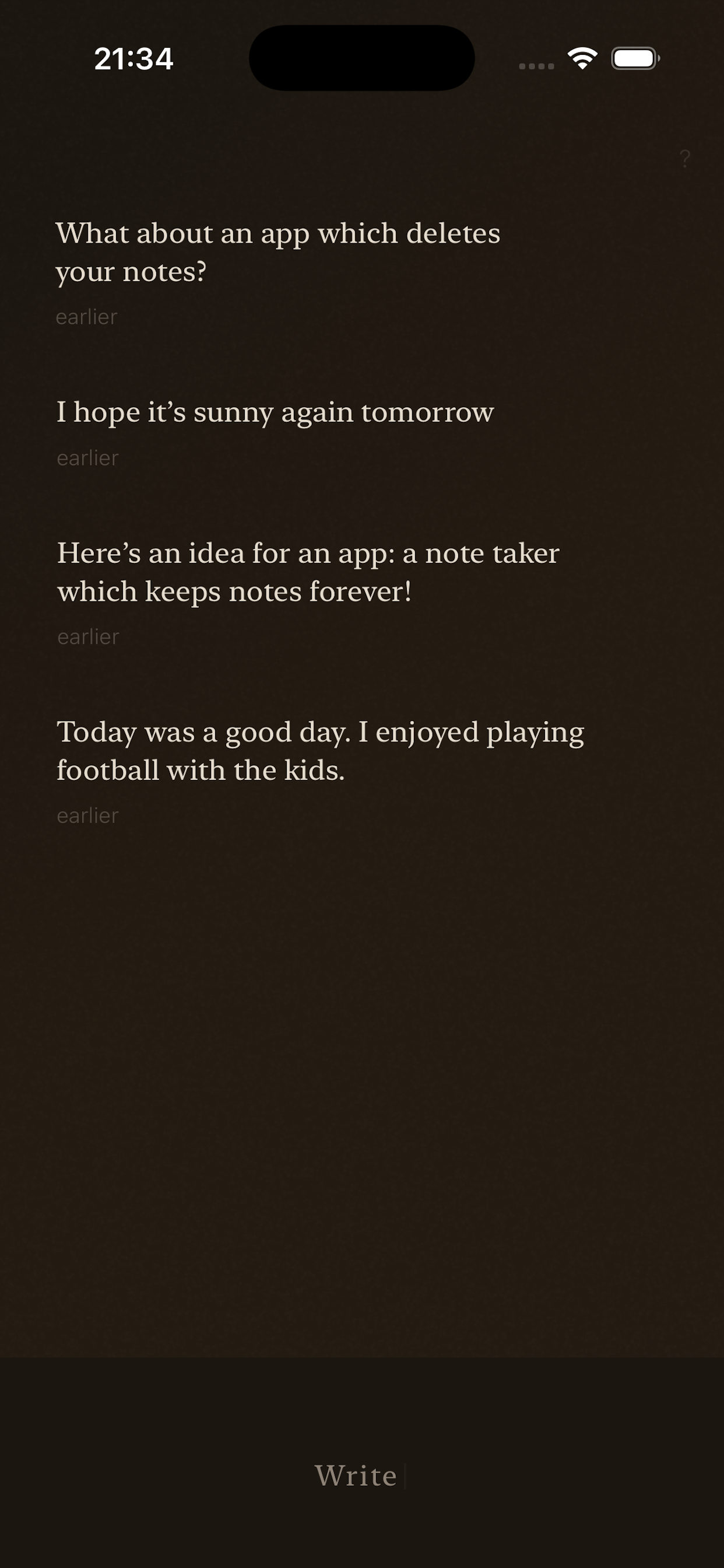
Open Drift and write whatever needs somewhere to go.
-
Lock
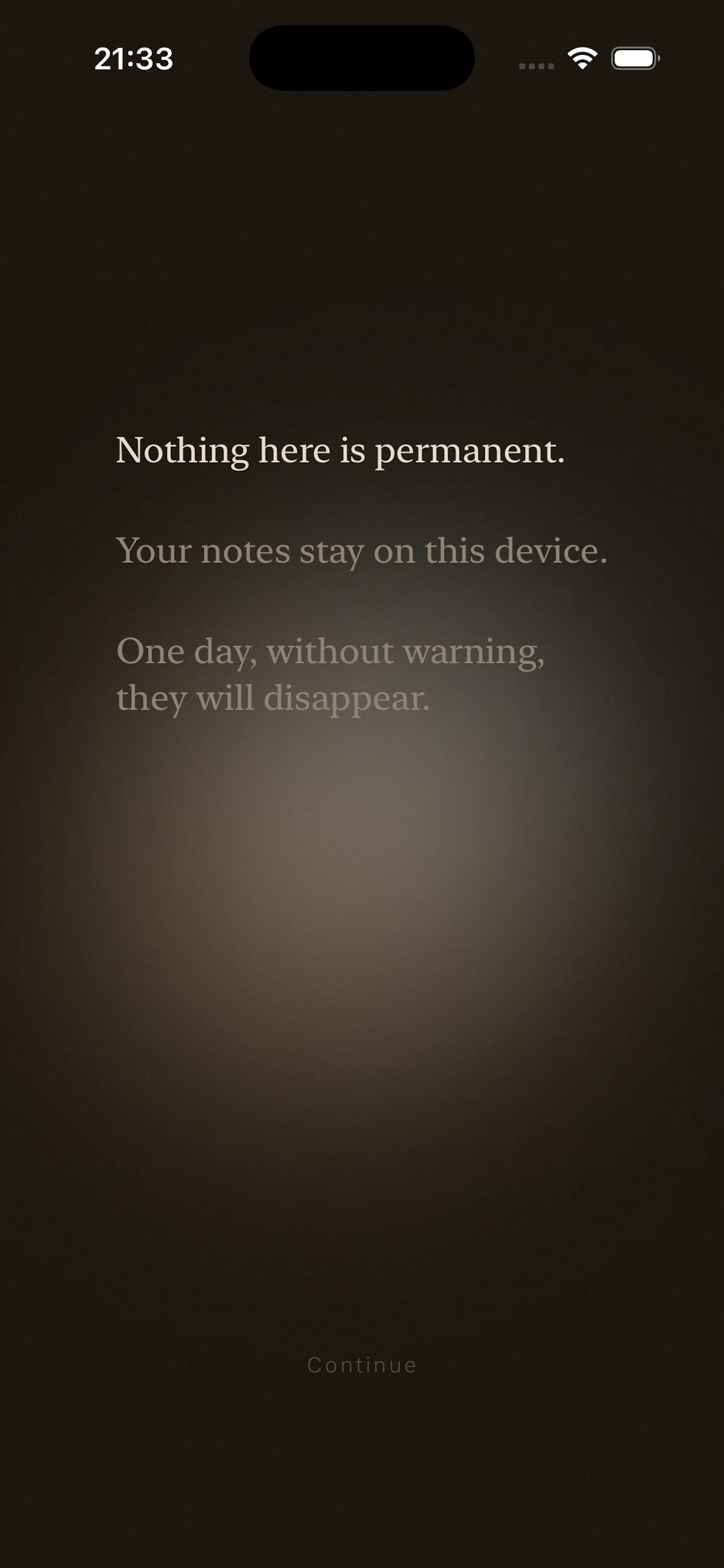
Your notes stay on your device and are protected by Face ID or your device passcode.
-
Let go
Every note is temporary. Some stay for days. Some stay longer. One day, without warning, they disappear.
Why let things disappear?
Most apps are built around keeping everything. Drift is built around a different idea: not every thought needs to become permanent.
Writing something down can help create distance from it. It can turn a feeling into words. It can move something out of your head and into a quieter place.
Drift gives that moment somewhere private to live, without asking you to keep it forever.
Built around the act of putting thoughts into words.
There is something that happens when you write a thought down. Research into expressive writing suggests that putting words to an experience can help you begin to make sense of it — to move it from something felt into something seen.
Research into affect labelling suggests that naming a feeling, even quietly and privately, can change how the mind holds it.
Research into cognitive offloading suggests that writing something down can free you from the effort of carrying it.
And around the act of letting them go.
Thoughts that have nowhere to go tend to stay. There is a body of research — known as the Zeigarnik effect — that describes this: unresolved things linger, occupying a kind of quiet background attention, until they find somewhere to land. Writing something down appears to give them that place. The thought is no longer loose.
A study published in Psychological Science found that people who wrote their thoughts on paper and then threw the paper away were less influenced by those thoughts afterward. The physical act of letting go seemed to matter — not imagining it, but doing it. The researchers described it as treating thoughts like objects. When the object is gone, something in the mind releases it too.
Separate research suggests that simply allowing a thought to exist — without fighting it — is associated with carrying it more lightly. What tends to make difficult thoughts heavier is the effort of resistance.
Drift is not therapy, and none of this is a promise. It is a private place to put something down — and then, in time, let it go.
Sources
- American Psychological Association — Expressive writing can help your mental health
- Baikie & Wilhelm — Emotional and physical health benefits of expressive writing
- Lieberman et al. — Putting Feelings Into Words
- Morrison & Richmond — Cognitive offloading
- Zeigarnik, B. (1927) — On finished and unfinished tasks — original research describing how incomplete tasks remain mentally active
- Masicampo & Baumeister (2011) — Consider it done! Plan making can eliminate the cognitive effects of unfulfilled goals — Journal of Personality and Social Psychology
- Briñol, Gascó, Petty & Horcajo (2013) — Treating thoughts as material objects can increase or decrease their impact on evaluation — Psychological Science
- Ford, Lam, John & Mauss (2018) — The psychological health benefits of accepting negative emotions and thoughts — Journal of Personality and Social Psychology / PMC open access
Deliberately simple.
- Local-only notes
- Face ID protection
- No account
- No sync
- No cloud storage
- No manual delete
- No recovery
- Notes disappear silently over time
- Photo attachments
- Home Screen widget to begin a new note
Support
Drift is intentionally simple. There are no accounts, no sync, and no recovery system.
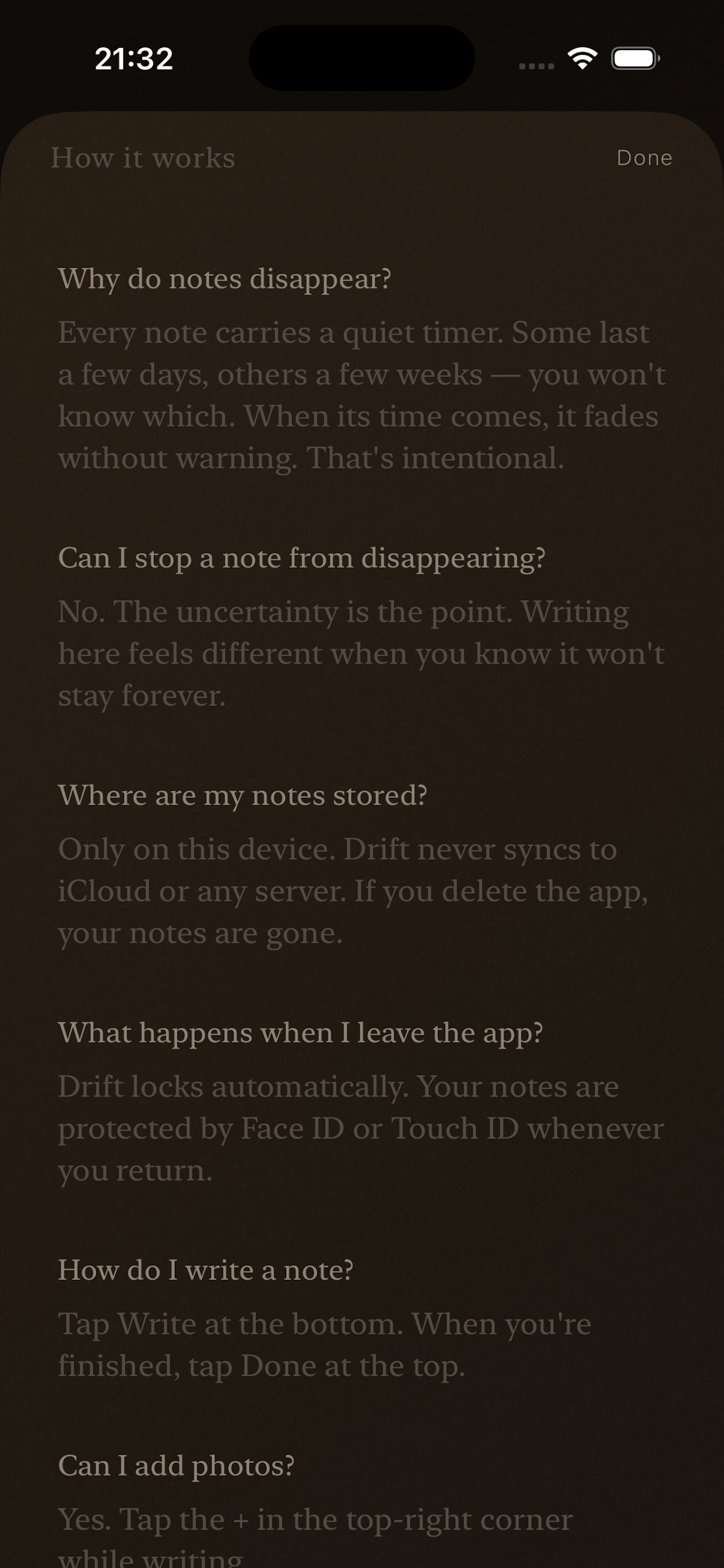
Can I recover a note that disappeared?
No. Once a note disappears, it is permanently removed.
Why did my note disappear?
That is the core behaviour of Drift. Every note is temporary and may disappear without warning.
Are my notes stored online?
No. Drift stores notes locally on your device.
Does Drift collect my notes?
No. Drift does not operate a server and does not collect your note content.
Does Drift use Face ID?
Yes. Drift uses iOS authentication to protect access to the app. Drift does not receive or store Face ID data.
Can I stop a note from disappearing?
No. Drift has no pinning, archiving, manual backup, or recovery.
For anything else, write to [email protected]
Privacy Policy
Drift is designed to be private and local.
- Drift does not require an account.
- Drift does not operate a server.
- Drift does not sync your notes.
- Drift does not sell your data.
- Drift does not use your notes for advertising.
Notes and attachments created in Drift are stored locally on your device.
Face ID and device authentication are handled by iOS. Drift does not receive or store your Face ID data.
Photos added to Drift are selected by you from your device library and stored locally within the app.
Drift's core feature is that notes may automatically disappear after a randomised period of time. Deleted notes are permanently removed and cannot be recovered.
If analytics, crash reporting, advertising SDKs, or third-party services are added in the future, this policy will be updated before release.
For privacy questions, write to [email protected]